Welcome to the Daily Skimm. Every morning in your inbox, we’ll skimm what you need to know to start your day — from can’t-miss news on weekdays to must-discuss lifestyle recs over the weekend. Let’s get you started with today’s newsletter.

Peak Danger
The Mountains Are Moving
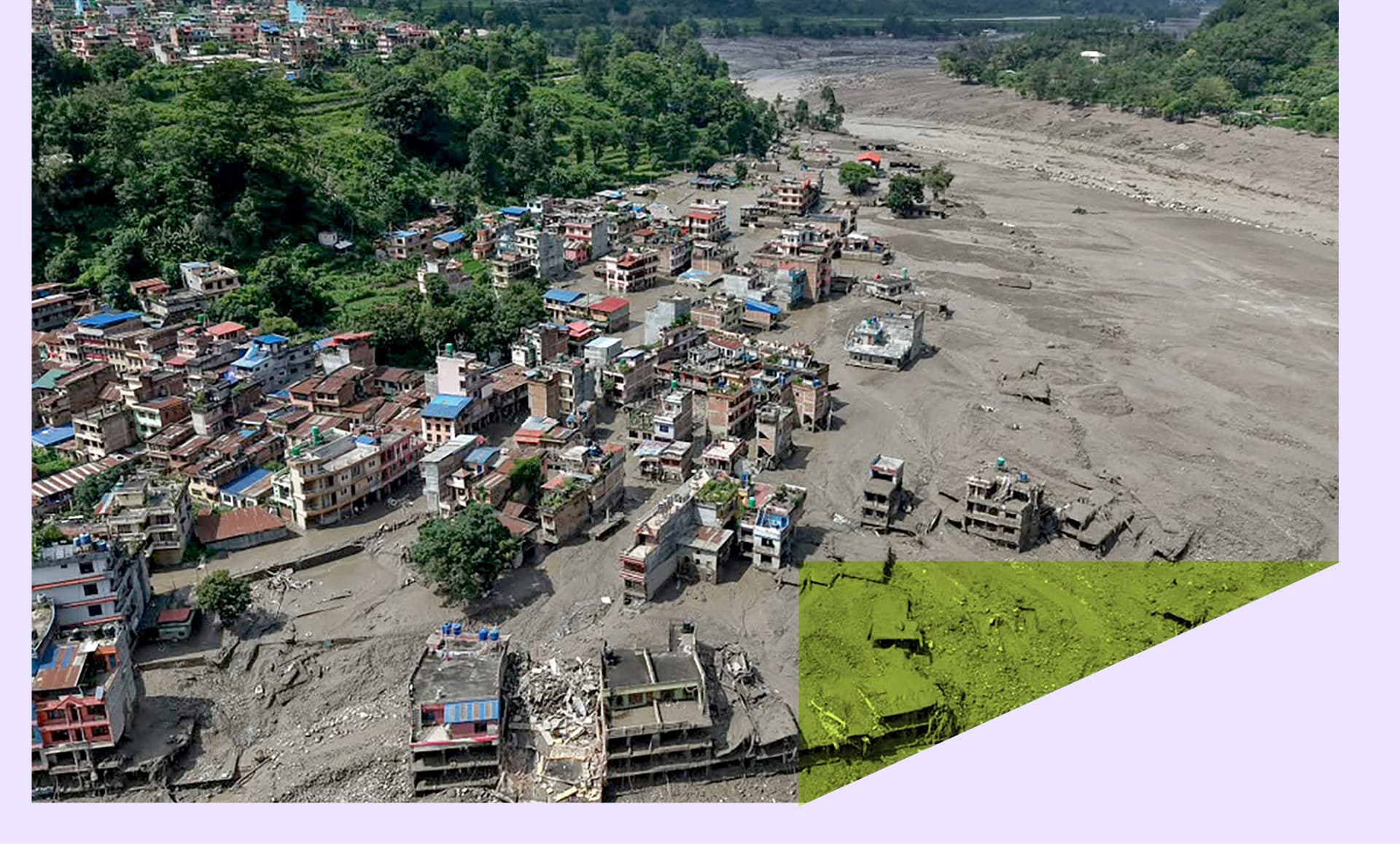
What’s going on: Scientists piecing together satellite images and seismic data believe a devastating landslide and glacial collapse in the Himalayas likely unleashed the floods on Wednesday in Nepal and Tibet. New satellite images show a huge section of mountainside gave way beneath a glacier just as a massive chunk of the glacier itself broke off. Together, researchers estimate the two collapses sent nearly 400 million metric tons of rock and ice crashing into the valley (roughly the weight of 1,000 Empire State Buildings) — and generated the equivalent of a 5.2-magnitude earthquake. Scientists say the debris picked up water and sediment as it tore downhill, creating an enormous wall of mud, ice, and water that traveled for dozens of miles. The catastrophe wiped out entire towns, roads, and bridges, killing at least 469 people in Nepal. More than 1,500 people remain missing across the disaster zone, including hundreds of tourists. US officials say about 90 Americans remain unaccounted for.
The bigger red flag: What happened in Nepal may be an extreme example of a risk scientists expect to grow as the planet warms. Rising temperatures are shrinking glaciers and thawing permafrost — think of it as the frozen glue that has helped hold mountain rock and ice together for thousands of years. As that grip weakens, some slopes can become more vulnerable to collapse. And that concern is growing as glaciers disappear faster. That instability has already led to devastation around the world. In recent years, glacier collapses have buried a Swiss village, killed 11 mountaineers in Italy, and contributed to floods that killed at least 200 people in India. Yet scientists still can’t reliably predict which glacier or mountainside could give way next. That makes Nepal’s timeline especially chilling: The torrent reached a busy border crossing just 10 minutes after the initial collapse — too fast for even the warning system to go off.
Related: A Visual Guide to How the Nepal and Tibet Floods Unfolded (The Guardian)
The News in 5
🗞️ A federal judge temporarily blocked the USPS from enforcing the Trump administration’s new mail-in voting rules.
🗞️ Two air-traffic controllers left work about an hour early before the deadly LaGuardia runway collision in March. The FAA is now moving to fire them as they investigate alleged timecard fraud.
🗞️ Nearly all Gary, Indiana, residents finally have power more than two weeks after a powerful storm ripped through the city.
🗞️ Lake Ontario has gone the way of the Gulf of Mexico after President Donald Trump signed an executive order to rename it “Lake America.” How will we remember the names of the Great Lakes without HOMES?
🗞️ General Mills says it has removed all artificial dyes from its US cereals, including favorites like Trix and Lucky Charms. Silly rabbit, Red 40 is not for kids.
In Our Rotation
Scientists have cracked the gut-GLP-1 connection — and turned it into the probiotic Halle Berry swears by. Did we mention it’s 48% off, plus HSA/FSA eligible?*
Until September 7, get 40% off running shoes that keep your feet supported on trails, treadmills, and pavements.
Sexism in Sports
Par for the Course?
What's going on: Usually, going viral is a good thing for a brand. But not in this case. Last Friday, sports media company Good Good Golf posted a video portraying the company’s cofounder knocking a woman — pro golfer Alexis Miestowski — to the ground when she reached for his Callaway golf club. The backlash was immediate, with many saying it normalized violence against women. The company quickly pulled the ad and apologized. But “I’m sorry” didn’t cut it for many. Over the course of this week, DICK’S Sporting Goods removed the brand from its stores and Callaway cut ties. And after the PGA Tour CEO spoke out against the commercial, Good Good Golf stepped away from its title sponsorship on Thursday. Some say the criticism is going too far, with one female Golf Monthly editor writing that the “online keyboard warrior machine” is blowing “bad advertising” out of proportion. Whatever your feelings, the video has sparked a conversation about sexism in golf.
A boys’ club: For some women, the backlash puts voice to a longstanding issue. “The ad feels like a very public version of the ‘locker-room talk’ or ‘golf-course talk’ women have been subjected to for decades,” Ellen Hyslop, co-founder of The GIST, told The Athletic. Golf is historically a male-dominated sport, but that’s been changing. From 2020 to 2025, there was a 45% rise in the number of on-course female golfers. But even with this increase, women make up just 28% of golfers overall. One woman golfer even compared Good Good Golf’s base to the manosphere. In their apology, Good Good Golf said their goal is to make the game more inclusive. But as Living Golf host Jasmine Sanders pointed out, "Golf keeps talking about making the game more welcoming to women. You can’t say that matters and then make violence towards a woman the punchline."
Related: Men Keep Throwing Sex Toys at WNBA Players (ESPN)
The Kids Might Be Alright
Maybe the Youth Will Save Us
What's going on: A group of teen girls in Alaska is here to prove young people aren’t as apathetic as their reputation might suggest. In Nome, they’re fighting for a ballot initiative that could raise the minimum wage to $25 an hour for the mostly Native population. The current minimum wage in the remote town — best known for its former gold rush glory and the Iditarod Sled Dog Race — is $14 per hour, the same as the rest of Alaska. Yet the cost of living is 69% more than the national average. Gas is frequently over $6 a gallon, milk is $10, and the next town is over 70 miles away (so price shopping’s out). And while it’s true that the town’s largest employer, Norton Sound Health Corporation, sets its minimum wage to $25 an hour already, the rest of the town’s workers are left in the dust. Things are so expensive that many people opt to hunt for their food, stocking walrus, fish, and caribou in their freezer. As one of the teens told The 19th: "I grew up living a very subsistence lifestyle.”
Tell me more: A town once besotted by prospectors for its marvelous quantities of gold is now struggling — and it took six teenage girls to get this voting effort going. Although some accuse young people of being detached, too online, and unwilling to work, the group’s momentum speaks for itself. One teen told The 19th she hopes the effort will make it easier for her to make a life if she moves home after college. This isn’t just a Nome issue. Across the country, economic uncertainty and high prices are affecting everyone, including Generations Z and Alpha. In a recent Harvard Youth Poll, instability (including financial) was the number one issue for Americans ages 18 to 29. And while naysayers worry the move could lead to some job cuts and higher business costs, the teens are closing in on their goal — while most kids are back-to-school shopping, they’re collecting signatures to get the proposal on the ballot. They need 108 by the end of the month. No pressure.
Related: Alaska Senate Campaign Stars Not One, Not Two, but Three Dan Sullivans (The Guardian)
Quick Hits
🎨 Behr’s 2027 Color of the Year is a “new neutral” with plenty of “warmth and depth.” We just need to know if Nancy Meyers would use it on set.
👀 Recovering from the “massage flu” isn’t exactly what we had in mind after a spa day. So much for rest and relaxation.
⚾ Twelve-year-old Kinley Rasmus, one of just two girls playing in the Little League World Series, tied the girls’ records for both strikeouts and hits. There’s no crying in baseball, but proud tears are allowed.
🍂 Costco’s latest dessert is music to our autumn-loving ears. Would pairing it with a PSL be too much?
👩❤️💋👨 BookTok girlies, rejoice: The first trailer for the movie adaptation of The Love Hypothesis has arrived.
☕ The Vera Bradley Gilmore Girls collection is back with cozy prints that are basically a love letter to Stars Hollow. Bringing this to the Dragonfly Inn.
🎤 Harry Styles paused opening night of his sold-out 30-show NYC residency to honor Dolly Parton, leading thousands of fans in an “I Will Always Love You” singalong. BRB, crying in a feather boa.
Skimm This
And the winning skimm is…
“Me on day one of PSL season”

With 43% of the vote, congratulations are in order for Stephanie M. from Encino, CA — this week’s champ. Reward yourself with a…well, you know.
Your next Skimm This drops on Tuesday. Same time, same place.
On Our Calendar
Friday, August 28
🧨 Coyote vs. Acme in theaters
This previously shelved animated-and-live-action movie follows Wile E. Coyote as he sues the Acme Corporation. One critic called it “the best Looney Tunes movie ever made, by far.” What do you think?
🍿 The Whisper Man out on Netflix
In this thriller, Robert De Niro plays a retired detective called in to help his estranged son, played by Adam Scott, search for the Whisper Man — a serial killer who may have abducted his 8-year-old. The trailer is as creepy as it is intriguing.
🎶 Daisy Chain Fields festival
Chappell Roan, Katseye, Bikini Kill, and other artists take the stage at Olivia Rodrigo’s festival — she’s headlining — in Irvine, CA. In the meantime, check out the event’s Etsy collection.
Saturday, August 29
🎾 International Tennis Hall of Fame Induction Ceremony
Roger Federer and broadcaster Mary Carillo are inducted this evening. Fun fact: One of them won the French Open with John McEnroe — and it’s not who you think.
Sunday, August 30
🏖️ National Beach Day
Skip the usual “best beach” debate. One stretch of sand was named the happiest in America.
Psst…this is just the preview: Subscribe to theSkimm app and never miss a moment.
KNOW IT ALL
In one of the last Instagram posts before his death, Tim Curry paid tribute to which of his iconic characters?


Love solitaire? Then you'll be obsessed with Pile-Up Poker. Climb the leaderboard.
Skimm'd by: Marisa Iallonardo, Molly Longman, Aryanna Prasad Bhullar, Erika W. Smith, Mallory Simon, Maria Corpus, Samantha Darby, Jessica Prois, and Marina Carver. Fact-checked by Sara Tardiff.
Welcome to the Daily Skimm. Every morning in your inbox, we’ll skimm what you need to know to start your day — from can’t-miss news on weekdays to must-discuss lifestyle recs over the weekend. Let’s get you started with today’s newsletter.

Peak Danger
The Mountains Are Moving
What’s going on: Scientists piecing together satellite images and seismic data believe a devastating landslide and glacial collapse in the Himalayas likely unleashed the floods on Wednesday in Nepal and Tibet. New satellite images show a huge section of mountainside gave way beneath a glacier just as a massive chunk of the glacier itself broke off. Together, researchers estimate the two collapses sent nearly 400 million metric tons of rock and ice crashing into the valley (roughly the weight of 1,000 Empire State Buildings) — and generated the equivalent of a 5.2-magnitude earthquake. Scientists say the debris picked up water and sediment as it tore downhill, creating an enormous wall of mud, ice, and water that traveled for dozens of miles. The catastrophe wiped out entire towns, roads, and bridges, killing at least 469 people in Nepal. More than 1,500 people remain missing across the disaster zone, including hundreds of tourists. US officials say about 90 Americans remain unaccounted for.
The bigger red flag: What happened in Nepal may be an extreme example of a risk scientists expect to grow as the planet warms. Rising temperatures are shrinking glaciers and thawing permafrost — think of it as the frozen glue that has helped hold mountain rock and ice together for thousands of years. As that grip weakens, some slopes can become more vulnerable to collapse. And that concern is growing as glaciers disappear faster. That instability has already led to devastation around the world. In recent years, glacier collapses have buried a Swiss village, killed 11 mountaineers in Italy, and contributed to floods that killed at least 200 people in India. Yet scientists still can’t reliably predict which glacier or mountainside could give way next. That makes Nepal’s timeline especially chilling: The torrent reached a busy border crossing just 10 minutes after the initial collapse — too fast for even the warning system to go off.
Related: A Visual Guide to How the Nepal and Tibet Floods Unfolded (The Guardian)
The News in 5
🗞️ A federal judge temporarily blocked the USPS from enforcing the Trump administration’s new mail-in voting rules.
🗞️ Two air-traffic controllers left work about an hour early before the deadly LaGuardia runway collision in March. The FAA is now moving to fire them as they investigate alleged timecard fraud.
🗞️ Nearly all Gary, Indiana, residents finally have power more than two weeks after a powerful storm ripped through the city.
🗞️ Lake Ontario has gone the way of the Gulf of Mexico after President Donald Trump signed an executive order to rename it “Lake America.” How will we remember the names of the Great Lakes without HOMES?
🗞️ General Mills says it has removed all artificial dyes from its US cereals, including favorites like Trix and Lucky Charms. Silly rabbit, Red 40 is not for kids.
Sexism in Sports
Par for the Course?
What's going on: Usually, going viral is a good thing for a brand. But not in this case. Last Friday, sports media company Good Good Golf posted a video portraying the company’s cofounder knocking a woman — pro golfer Alexis Miestowski — to the ground when she reached for his Callaway golf club. The backlash was immediate, with many saying it normalized violence against women. The company quickly pulled the ad and apologized. But “I’m sorry” didn’t cut it for many. Over the course of this week, DICK’S Sporting Goods removed the brand from its stores and Callaway cut ties. And after the PGA Tour CEO spoke out against the commercial, Good Good Golf stepped away from its title sponsorship on Thursday. Some say the criticism is going too far, with one female Golf Monthly editor writing that the “online keyboard warrior machine” is blowing “bad advertising” out of proportion. Whatever your feelings, the video has sparked a conversation about sexism in golf.
A boys’ club: For some women, the backlash puts voice to a longstanding issue. “The ad feels like a very public version of the ‘locker-room talk’ or ‘golf-course talk’ women have been subjected to for decades,” Ellen Hyslop, co-founder of The GIST, told The Athletic. Golf is historically a male-dominated sport, but that’s been changing. From 2020 to 2025, there was a 45% rise in the number of on-course female golfers. But even with this increase, women make up just 28% of golfers overall. One woman golfer even compared Good Good Golf’s base to the manosphere. In their apology, Good Good Golf said their goal is to make the game more inclusive. But as Living Golf host Jasmine Sanders pointed out, "Golf keeps talking about making the game more welcoming to women. You can’t say that matters and then make violence towards a woman the punchline."
Related: Men Keep Throwing Sex Toys at WNBA Players (ESPN)
The Kids Might Be Alright
Maybe the Youth Will Save Us
What's going on: A group of teen girls in Alaska is here to prove young people aren’t as apathetic as their reputation might suggest. In Nome, they’re fighting for a ballot initiative that could raise the minimum wage to $25 an hour for the mostly Native population. The current minimum wage in the remote town — best known for its former gold rush glory and the Iditarod Sled Dog Race — is $14 per hour, the same as the rest of Alaska. Yet the cost of living is 69% more than the national average. Gas is frequently over $6 a gallon, milk is $10, and the next town is over 70 miles away (so price shopping’s out). And while it’s true that the town’s largest employer, Norton Sound Health Corporation, sets its minimum wage to $25 an hour already, the rest of the town’s workers are left in the dust. Things are so expensive that many people opt to hunt for their food, stocking walrus, fish, and caribou in their freezer. As one of the teens told The 19th: "I grew up living a very subsistence lifestyle.”
Tell me more: A town once besotted by prospectors for its marvelous quantities of gold is now struggling — and it took six teenage girls to get this voting effort going. Although some accuse young people of being detached, too online, and unwilling to work, the group’s momentum speaks for itself. One teen told The 19th she hopes the effort will make it easier for her to make a life if she moves home after college. This isn’t just a Nome issue. Across the country, economic uncertainty and high prices are affecting everyone, including Generations Z and Alpha. In a recent Harvard Youth Poll, instability (including financial) was the number one issue for Americans ages 18 to 29. And while naysayers worry the move could lead to some job cuts and higher business costs, the teens are closing in on their goal — while most kids are back-to-school shopping, they’re collecting signatures to get the proposal on the ballot. They need 108 by the end of the month. No pressure.
Related: Alaska Senate Campaign Stars Not One, Not Two, but Three Dan Sullivans (The Guardian)
Skimm This
And the winning skimm is…
“Me on day one of PSL season”

With 43% of the vote, congratulations are in order for Stephanie M. from Encino, CA — this week’s champ. Reward yourself with a…well, you know.
Your next Skimm This drops on Tuesday. Same time, same place.
KNOW IT ALL
In one of the last Instagram posts before his death, Tim Curry paid tribute to which of his iconic characters?

Skimm'd by: Marisa Iallonardo, Molly Longman, Aryanna Prasad Bhullar, Erika W. Smith, Mallory Simon, Maria Corpus, Samantha Darby, Jessica Prois, and Marina Carver. Fact-checked by Sara Tardiff.
Live Smarter
Sign up for the Daily Skimm email newsletter. Delivered to your inbox every morning and prepares you for your day in minutes.
