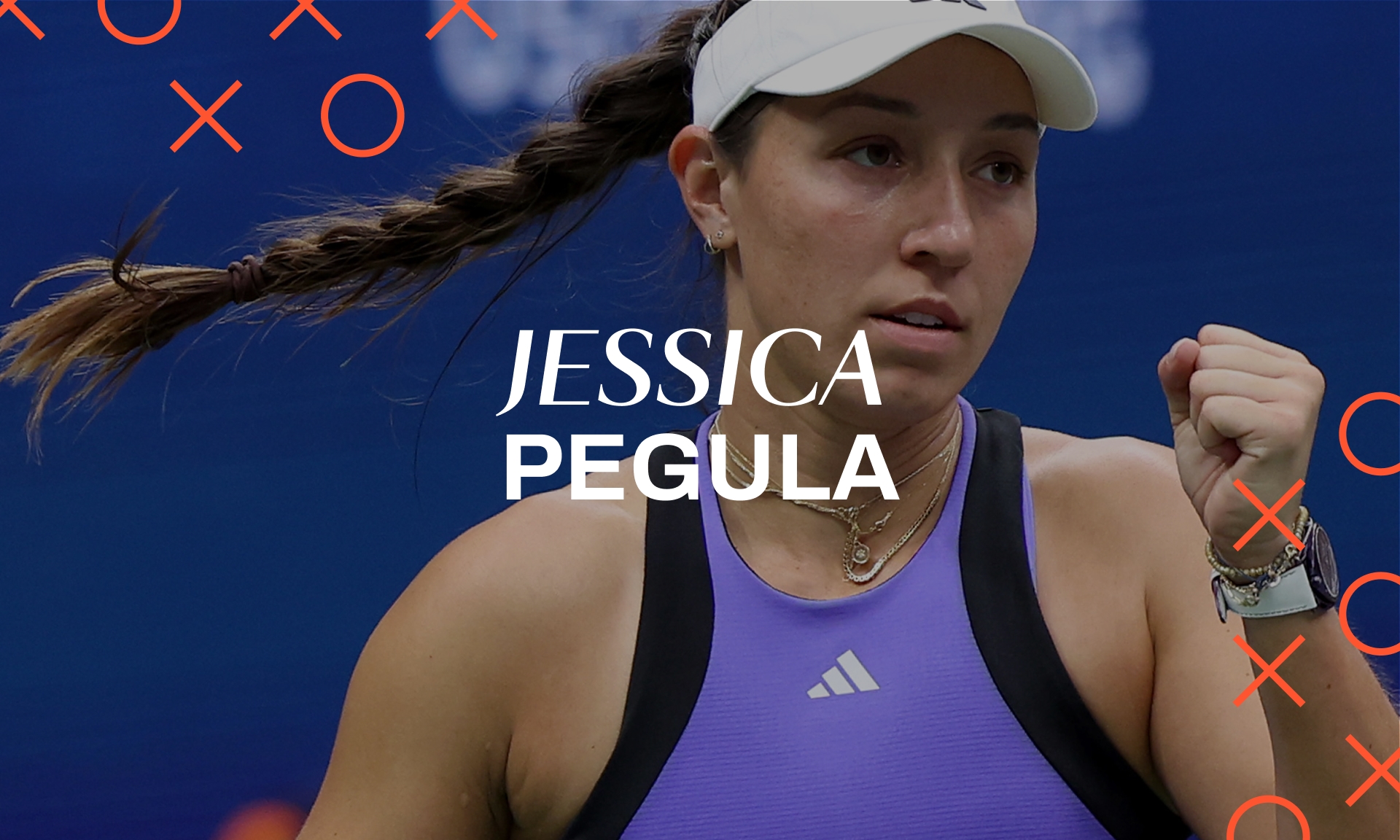
If Coco Gauff could trade lives with any other tennis player, she knows exactly who she’d choose: Jessica Pegula. She recently told the Women's Tennis Association (WTA) that it was due to “financial reasons.” Pegula, whose parents own the Buffalo Bills and Buffalo Sabres, laughed right along with her.
But Pegula has plenty going on besides her last name. She’s one of the players pushing Grand Slam organizers for changes to prize money and player representation, and she and her husband, wealth manager Taylor Gahagen, founded A Lending Paw, a nonprofit that works with rescue dogs to help train and place service animals with people who need them.
Heading into the US Open (which kicked off on Sunday, and where Pegula is expected to be number three seed, playing early next week), Pegula is buckling down on the basics as she plans her season peak. After injuries disrupted the early part of her career, she became more deliberate about how she takes care of herself, inside and out. Her partnership withVital Proteins, the official collagen partner of the US Open, has become part of that routine as she prepares to compete in New York.
theSkimm caught up with Pegula about her pre-tournament prep, plus the one surprisingly simple thing she does when a match starts going sideways.
In the lead up to the Open, how are you preparing?
“I had a lot of injuries in my early 20s and had to reconfigure how I could better take care of myself and my body. This sport isn’t just about being ready for one week. It’s week after week, pretty much all year round.
There’s so much importance on recovery nowadays. Everyone wants to stay healthy, and I think staying healthy is the number one priority because if you’re not you’re not going to be able to put your best foot out there.
Over the last couple of years, I’ve been able to be really consistent. That wasn’t always the case when I was younger. A lot of that is just me taking better care of myself and controlling what I can off the court.”
At this point in your career, what do you know about your body that you wish you’d known when you were 18, 19, or 22?
“I don’t think I realized how important consistency is. And not just being consistent with something really drastic, but how little things really add up over time.
Being a little more professional with my warmups and recovery, realizing that a 20-minute warmup where you’re really working on things or working on how to get stronger — that adds up.
Before, I think I thought, ‘You’re doing too much.’ I didn’t want to be that person doing all this stuff and then you go out and lose. Then it flipped because I was like, ‘I need to stay healthy. I need to do everything possible.’
So I decided I was going to do little things every single day and commit to it. And I saw that take my game to the next level.”
Tennis is filled with so many variables you can’t control. What’s one recovery or mental strategy that helps you keep playing at this level?
“For me, a big thing I’ve grown into and that I’m good at is managing my emotions.
There’s a lot of adrenaline on the court. There are a lot of things happening. And I think I’ve done a really good job of realizing that managing your emotions is a big part of it.
You don’t want to be super up and down throughout a match or tournament. That always zapped my energy a bit. I’d become very up and down if I got too excited or too pumped up or too negative.
Even if it’s too much positivity, it kind of zaps my nervous system. Then I feel like I have a lull because I was overly excited. Everyone is different, and you have to find the balance that works for you. But they’re huge parts of playing a match and an entire tournament as well.”
When you can feel things starting to shift in a match, is there anything you say to yourself or do to flip the script?
“You can definitely feel when things are starting to shift, or maybe they’ve already shifted and you’re trying to stop the bleeding a little bit.
For me, it always comes down to competing. Sometimes you’ve just got to dig your heels in and say, ‘I’m just going to make this really hard for this person. I don’t care what happens. I’m there every single point. I’m not negative. I’m just going to fight.’
And I also think thinking more clearly is really helpful, which is why managing your emotions matters. It helps you think more clearly about what your game plan is and what you need to do.
Sometimes you get lost in the excitement or frustration and you’re not thinking, ‘Oh, wait. Maybe I’m actually playing this person in the wrong way, and that’s why I’m losing.’
So I try to stay present, take it point by point, and think about what I’m trying to accomplish. Maybe it’s, ‘This girl’s backhand is not good. I’m just going to hit every ball to her backhand and see what happens.’
Or it could be focusing on making first serves. Just focusing on one thing can take all the extra stuff out of it.
Then all of a sudden things start coming together. You’re like, ‘OK, I’m starting to play a little better. She’s missed a couple balls. Maybe I have a chance right now to shift the momentum back.’
I focus on really small, strategic things: ‘This is your goal. Your goal is to hit every ball to this corner. That’s it.’ It can get you out of some really tough moments.
It’s funny how simplifying can help open things up. I’ve had moments where I’m like, ‘Oh my gosh, why wasn’t I doing this before?’ It was such an easy thing I could focus on. ‘Why didn’t I think about this sooner?’ But it works. It does help.
This interview has been edited and condensed for clarity.