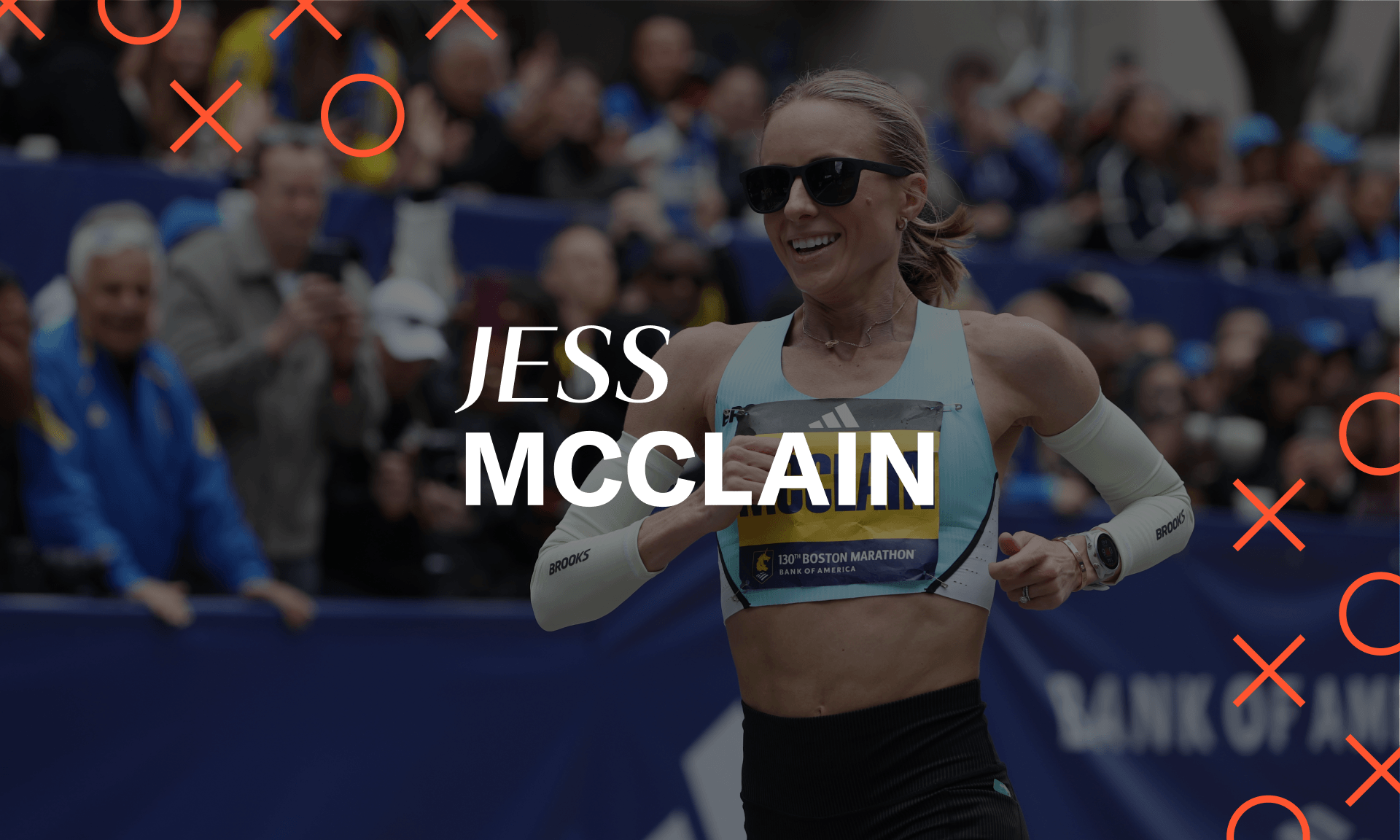
After 26.2 grueling miles through the five boroughs, not to mention a thrilling, late-race surge past defending champion Hellen Obiri to claim second place at the New York City Marathon, Jess McClain didn’t reach for a recovery shake. She celebrated by biting into a chocolate bar shaped like a yellow cab. It was just as sweet as her place on the podium (the first American woman to do so since 2018), and the exact kind of whimsical reminder she needed: Running is supposed to be fun.
By noon the next day, McClain was already wheels up on a flight back home to Scottsdale, Arizona. The 34-year-old athlete juggles running professionally for Brooks Running and her role as the executive director of the Love Up Foundation, a nonprofit advocating for children in foster care. McClain pours her whole heart into both jobs, and having a higher purpose beyond split times keeps her grounded: “I can move on to the next thing that I love doing,” she says.
Still, even elite athletes get caught up in the cultural craze. Just like the rest of the country, she spent her post-race recovery glued to her phone, endlessly scrolling through race-day vibes and spectator chaos taking over MarathonTok.
The breakthrough in New York, however, started in her head. Right before toeing the line, her coach shared words she’d never heard before in her athletic career: “I would be proud of your C-minus day. I would be proud of your A-plus day. Just go and be Jess.” That radical permission to be human took the weight off her shoulders, freeing her to throw down everything she had on the pavement. Once she locked in, she realized the podium was hers for the taking.
McClain caught up with theSkimm to talk about rediscovering the joy in racing and her real-life lessons in starting again.
What was going through your head in the final stretch?
Heading into [Central] Park, I was doing a lot of mental work, just trying not to give up and taking the shortest distance through the turns and the curves of the park. And then the last 400 meters, I’m like, “Oh my God, I think I’m going to podium. I’m going to take these sunglasses off and soak it all in.”
But then I was like, “Wait, I think I can get second place.” I was watching Hellen [Obiri] and Sheila [Chepkirui] duke it out for two miles, and I realized, “OK, once one of them loses that battle, you don’t know how they’re going to react to having fallen off the lead.”
I felt so good with 400 [meters] to go, and I just visualized all those moments in training where I did my fast repeats and reps thinking about that particular stretch.
And when you crossed the finish line?
Everything just hit me. I was just like, “Finally, I have a performance where it’s like I knew I could do it and I actually did it.” It was just very cool.
To have been so close to the lead was very, very cool and something that will motivate me going forward.
Your coach told you he’d be proud of your C-minus day or your A-plus day. What did that do for your mindset going into New York?
A coach has never said that to me before. Just go be you. It just gave me a lot of confidence. It made me feel like I had everything I needed to go have a big day if I wanted to do that.
He wasn’t like, “All right, let’s podium or bust.” It was just, let’s go in and do exactly what you do best, where it’s reading the race and then having a really strong last 10K and really hammering the hills where I could.
Usually I’m kind of a stress ball with nervous energy about five days out. Usually I feel like garbage on my last workout, and I felt amazing for this one. I was just so excited.
You initially came back to competing for fun. What made you want to come back?
I wanted to run a marathon to celebrate my 30th birthday. So I signed up for a local one here six to eight weeks before it was happening. It wasn’t this very well-thought-out traditional marathon build. It was just a, “Hey, our body’s been feeling better doing a little bit of harder runs and training. Let’s run a marathon, celebrate feeling good, [and] being healthy.”
I ended up going to Dick’s Sporting Goods the night before because I didn’t have shoes, but I didn’t stress about it. I’m like, “OK, we’ll go buy shoes.” And then I packed two gels for the whole morning —one for before the race, one for during — and then had to stop to use the bathroom.
There were a lot of things that went wrong, but I ran a 2:33 and had so much fun doing it. My high school friends came out and surprised me on the course with signs. I was like, “Man, I think I could do this marathon thing.”
How do you fit professional running around your job?
I just love having different buckets to pour myself into, especially with running being what it is now. It’s nice on the days when things don’t go my way; I can move on to the next thing that I love doing.
It’s taken a minute to get to the point where I feel like it’s a balance and I’ve got it under control, but I work from home three days a week, so it’s very manageable, [and I] get to be out in the community the other days of the week.
“New York was a fun block because my job is really low-key [in] July and August. I was able to go to Flagstaff in Arizona and just focus on running. I still worked a decent amount, but it was just like, “Let’s go to the mountains, run with a ton of amazing friends and athletes, and have running be the main focus.”
What do you wish you’d known when you first became a professional runner?
I wish I took more ownership of my career as a young athlete, but you don’t know how to do that.
I think there’s also something to be said for really having fun. As a pro, I was like, “This has to be so serious. It shouldn’t be play and work. It’s all work. I want to make an Olympic team. I want to win global medals. I need to be a machine and a robot to do that.” I’m not somebody that can function that way. I need it to be really, really fun.
My advice would be to find your recipe and enjoy the work it takes to figure out what that recipe is. Nobody can really figure that out for you.
Do you have any advice for a young athlete negotiating a contract?
Make relationships with brands. Don’t be scared to send multiple emails and follow up. I was so shameless coming out of the Olympic trials. I put a one-pager together. I sent it on LinkedIn; I sent it on Instagram. Just shoot your shot.
In terms of contracts, really read through every single thing. If you don’t understand the legalese, try to find somebody [who] can help you. Luckily, my dad and my husband are great at contracts, so they’ve been helping me a ton, but ask a ton of questions.
It’s easy to think about what a contract means if everything goes right. But as an athlete, injuries and hiccups and all of these hurdles are inevitable. So how does this contract reflect if those things were to happen?
What would you say to runners finishing in the middle or back of the pack?
I’ve gotten so many DMs where it’s like, “Oh man, I’m a five-hour marathoner.” I’m like, “You’re a marathoner just like we are at the front of the pack.”
Being an elite and a professional in these fields is such a privilege and so fun, but there’s so much magic that’s happening behind us. I spent the last two days, when I should have been productive just scrolling through New York Marathon TikTok and Instagram videos.
You’re a runner if you’re doing walk-jogs; you’re a runner if you’re only doing 15 miles a week. It’s cool to just be in the arena.
Find some good training buddies to meet in the mornings and evenings after work, if that helps. Keep it fun and try not to put too much pressure on yourself, because there are so many things in a marathon that can go sideways. Focus on what you can control.
How are you thinking about LA 2028?
I want to be on the team. That’s the top goal moving forward. We’re kind of working backward from that, [thinking about]what races and what kind of training will be conducive to not only performing well in races along the way, but obviously set me up well to run [at the trials] and get top three.
It’s not something I write on my mirror and think about every day. But it’s something I really want.
What advice do you have for someone trying to find their way back to something they love?
I’ve very rarely celebrated a small personal best or stringing together three weeks of healthy running. I was just so focused on the outcome and results. And oftentimes I didn’t hit my goals, so I just felt super defeated and kind of lived in this space of fear and failure.
I think reframing failure is super important. It’s OK to fail. It’s really cool to try, [fail], and then try again.
It’s always amazing to find your way back to something, but it’s OK to take a break and take a step back, because oftentimes you come back with a healthier perspective.
Buzzer Beaters
Pre-race music? Really fun millennial throwback remixes. Something that just gets me hyped up, has a really good beat.
Favorite non-running workout? I love to go for a long walk. I do love to lift. I don’t do a ton of weightlifting, but [high-intensity] interval training is super fun where you have a great class and really good music.
What have you been watching? I just finished the most recent season of Ted Lasso. I love that show. It makes me cry all the time. It was great vibes to watch before New York.
This interview has been edited and condensed for clarity.