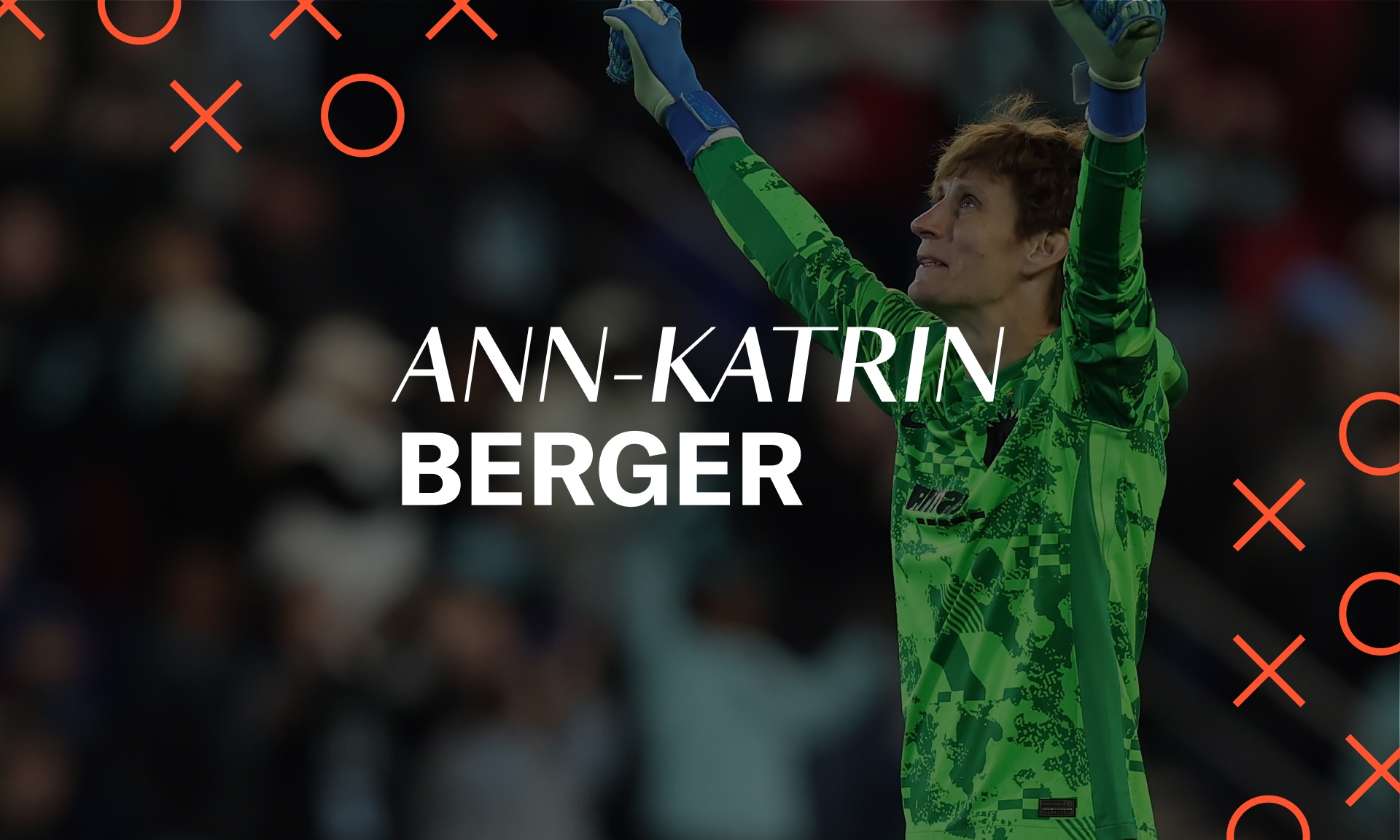
On game day, Gotham FC goalkeeper Ann-Katrin Berger has a surprising trick up her sleeve. While other athletes crank up the music to get hyped, she often reaches for a playlist full of “very sad, heartbreaking, slow-beat songs.” You know, like Adele.
The energy before a match can get a little overwhelming, she tells theSkimm, so she'd rather dial it down. It's a trick Berger (who also plays for the German national team) learned from her mom: Music can help her manage her emotions. Considering she's one of the world's best goalkeepers, who are we to question her methods?
Clearly, it’s working. The 36-year-old German international has an Olympic bronze medal, was just named one of three goalkeeper finalists for the world's best soccer team, helped Gotham capture its first-ever National Women’s Soccer League (NWSL) Shield (the league's regular-season title), and was nominated for Goalkeeper of the Year. On Sunday, she helped send Gotham to the semifinals with her 12th scoreless match of the season and yet another spectacular save.
But if you ask her about any of her awe-inducing saves (including this jaw-dropping stop against France at Euro 2025), she's almost comically matter-of-fact. Don't mistake that for a lack of competitive fire, though. “Every time I concede a goal, I'm fuming,” she says, and you can hear the shift in her voice. “I absolutely hate conceding goals.”
With the 2027 Women's World Cup on the horizon, we asked Berger about everything from how she handles pregame pressure to the unexpected way she keeps giving her Gotham teammate Emily Sonnett a serious case of FOMO.
You've made some incredible saves throughout your career. What's your biggest strength as a goalkeeper?
I think my biggest strength is reading the game before something happens. Over the years, the game has changed. Everything has gotten quicker and more professional, with more power behind shots, so I've had to adapt.
I pride myself on having less to do during a game because that means I've prevented a lot of things before I actually have to [make a save]. That's my best game.
When did you realize you could make saves that look physically impossible? Don't tell me it's just the camera angles.
Sometimes the cameras definitely get the right angles. But I would never say I'm an incredible goalkeeper. Sometimes you just have to do whatever you can to keep the ball out of the net.
A lot of people talk about my save at the Euros, but honestly, I have no idea how it looked like that. In the moment, it didn't feel the way it looks in pictures or videos. I think it's more about [my] determination to keep the ball out of the net.
Walk us through how you prepare for a big match. What's something fans might not expect?
Honestly, I don't prepare as much as a lot of people do. Here in America, the turf is completely different, so I go out before warm-ups to see how the ball bounces and how big the pitch is. Even two or three yards can make a big difference for my positioning and distribution.
We prepare as a team and study our opponents, but beyond that, I don't want to know too much. Even if a player makes the same move 99% of the time, they might do something different in a World Cup match because of the nerves or the occasion. I want to keep an open mind and read the game as it happens.
You've said you actually love penalty shoot-outs. Most people would consider those incredibly stressful. What's your secret?
I think the pressure is more on the striker. People expect them to score. Of course, I get paid to save the ball, too, but in a one-on-one situation, it’s about the striker.
That's why I can stay so calm. Nobody expects me to save those kinds of shots. You have to stay patient for as long as possible and read the player. That's the next step for a lot of goalkeepers: learning to read players a little more.
Does that same calm carry over into your everyday life?
People always tell me how quiet and calm I am. If I scream or say something loudly, it must be really bad because I'm not someone who says a lot.
You're known for your dry sense of humor. Are you funnier in English or German?
Definitely English, apparently. I think it's because I use very simple words, and sometimes people think I'm joking when I'm actually serious. They just start laughing.
I'm very short and direct. I'm not even trying to be funny. Why should I talk around something instead of getting to the point? And I have to say, my German isn't as great anymore, so I think I'm definitely funnier in English.
What's the best money advice you've received, especially knowing that an athlete's career doesn't last forever?
My mom always told me to stay in school as long as possible. When I became a professional footballer, even some of the really great players in Germany had part-time jobs because they couldn't afford to play football full time. As I started earning more money, I saved quite a bit.
My mom always said to prepare for life after football and figure out what you might want to do next, even while you're still playing. There are so many opportunities now in women's football to take courses and explore other interests. And you always have to remember that an injury could end your career early. It doesn't matter whether you're a man or a woman. You have to be prepared for another life.
Final Whistle
What's something you're secretly amazing at that has nothing to do with soccer?: Baking. I love making apple cake. The team absolutely loves my apple cake, so I have to make it quite often. Emily Sonnett has already given me a lot of sh*t because she's been out [with an injury] and every time she sees that I've baked one, she's fuming.
What's one thing you always carry in your bag?: Most of the time, I don't even have a bag. But my phone, keys, and wallet: I check for them every time I leave the house.
If you weren't an athlete, what would you be?: At first, I thought about becoming a sign-language interpreter because my sister is deaf. But nowadays, I'd say I really want to be a goalkeeper coach.
This interview has been edited and condensed for clarity.